
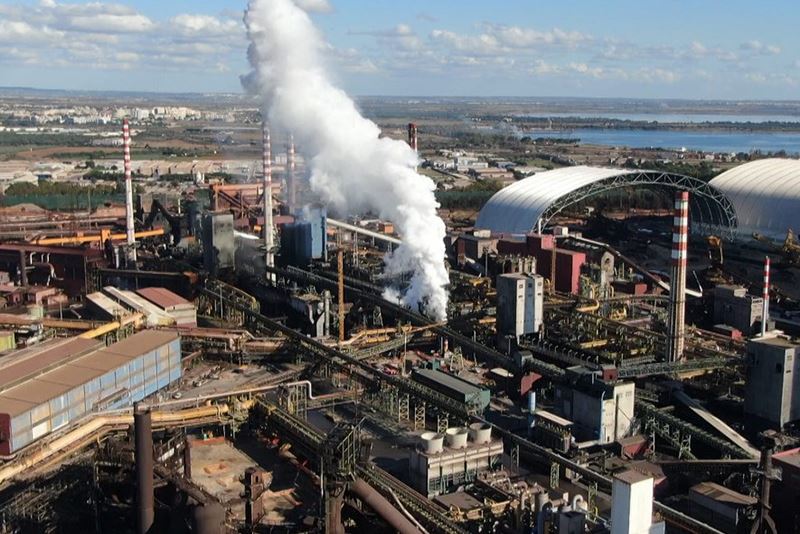
In recent years, the plant in Taranto has produced no more than 2–3 million tonnes of steel per year
The Milan Court of Appeal has dismissed an appeal by the operator, Acciaierie d’Italia, and upheld the ruling ordering the shutdown and reclamation of the hot zone at the former Ilva steelworks in Taranto. This was reported by Reuters.
The decision was prompted by inadequate environmental safety measures and high levels of environmental pollution, which pose a threat to the health of local residents.
This court ruling has dealt a significant blow to the plans of Prime Minister Giorgia Meloni’s government, which had been attempting to keep the country’s largest steelworks operational whilst a new investor was sought. The steelworks is the only one in Italy that operates a full production cycle, processing iron ore and coal in blast furnaces. The plant is of strategic importance to the country’s industry, supplying raw materials to the construction and automotive sectors.
Acciaierie d’Italia has warned that shutting down the hot shops jeopardises the entire production process. If the blast furnaces are allowed to cool down, it will be impossible to restart them without lengthy and costly repairs.
The Ilva steelworks has for years been at the centre of heated debates concerning the environment, public health, industrial policy and employment. The plant provides employment for around 8,000 permanent staff and numerous contractors in a town with a population of fewer than 200,000.
The company is currently under emergency state administration. With the national elections approaching, the government is seeking alternative ways to save the site. Alfredo Mantovano, Deputy Chief of Staff to the Prime Minister, stated that the authorities are considering retaining the state’s stake in the company and switching to more environmentally friendly technologies — in particular, electric arc furnaces using direct reduced iron (DRI).
For its part, the Italian association ASSOFERMET expressed deep concern over the Milan Court of Appeals’ decision to uphold the shutdown order for the hot end of the Taranto steel plant. Acciaierie d’Italia plans to begin cooling down its blast furnaces on September 16, a process described as difficult to reverse and costly to restart. As Italy’s only integrated steelworks, Taranto supplies key processing plants in Genoa and Novi Ligure. Its closure threatens national supply security, increases reliance on imports, and risks critical steel shortages for automotive, machinery, and construction sectors, especially under tight EU import quotas and 50% tariffs.
The Italian government is considering the possibility of launching a new tender for the Acciaierie d’Italia steelworks — this could take place in September. There are currently two major constraints: the suspension of operations in the plant’s hot zone, recently ordered by the court, and the financial stability of Acciaierie d’Italia, which is currently operating thanks to an EU loan that is due to expire shortly with no option for renewal.
Related Posts
- ▶ Court Upholds Shutdown of Acciaierie d'Italia Blast Furnaces in Taranto
- ▶ IREPAS: High-Grade Rolled Steel Prices Under Pressure
- ▶ Canada doubles counter-tariff on US steel to 50 percent, effective September 8
- ▶ Industrial production in the EU rose by 0.2% m/m in June
- ▶ Canada Has Launched A Discount Scheme For The Transport Of Steel Products
- ▶ ArcelorMittal 1H2026 Revenue Rises to $32.2 Billion
- ▶ The US has imposed new tariffs on 60 trading partners
- ▶ Nucor Raises US Hot-Rolled Coil Prices to $1,135/t
- ▶ Formosa is cutting prices for hot-rolled steel for sale in August and September
- ▶ EU Steel Import Restrictions Challenge South Africa
Online Message


Leave A Message
If you are interested in our products and want to know more details, please leave a message here, we will reply you as soon as we can.