
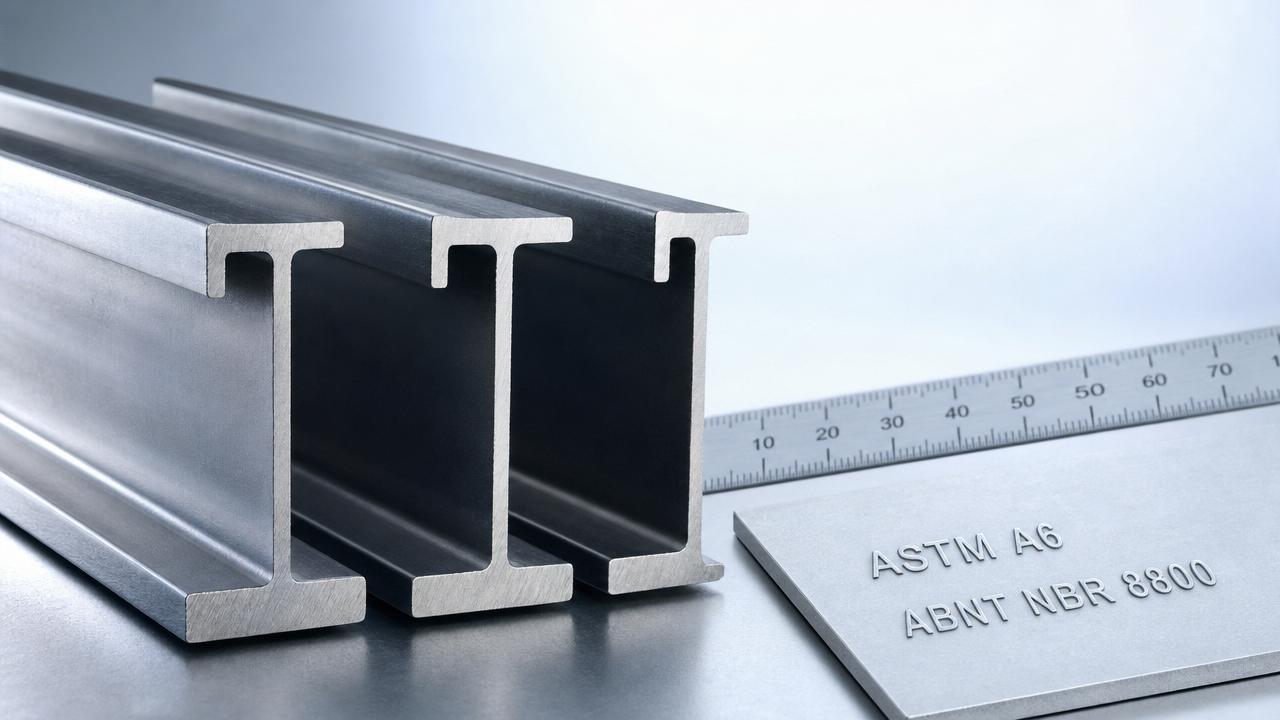
Brasília, May 12, 2026 — Brazil’s National Institute of Metrology, Standardization and Industrial Quality (INMETRO) issued Portaria No. 112/2026, formally adding hot-rolled H-beams and I-beams to its fourth batch of products subject to mandatory energy efficiency labeling. Effective January 1, 2027, all such steel sections imported into Brazil must carry an IE3-class (or higher) energy efficiency label and be accompanied by test reports from INMETRO-accredited laboratories. The regulation directly affects Chinese steel exporters—particularly producers of structural hot-rolled H-sections—and signals a tightening of technical market access requirements in Latin America’s largest economy.
Event Overview
On May 12, 2026, INMETRO published Portaria No. 112/2026, amending the scope of Ordinance No. 154/2020 (the Energy Efficiency Labeling Program). The amendment explicitly includes hot-rolled H-beams and I-beams under mandatory labeling, effective January 1, 2027. Compliance requires: (1) classification as IE3 or higher per INMETRO’s adopted methodology; (2) testing conducted exclusively by INMETRO-accredited laboratories; and (3) alignment with dual standard requirements—ASTM A6/A6M (U.S.) and ABNT NBR 8800 (Brazilian structural design standard)—for dimensional, mechanical, and energy-related performance verification.
Industries Affected
Direct Exporters (Trading Companies & Steel Mills)
Export-oriented Chinese steel mills and trading firms supplying H-beams to Brazilian construction, infrastructure, and industrial clients face immediate compliance pressure. Non-compliant shipments risk customs rejection, retesting delays, or forced labeling corrections at destination—potentially triggering contractual penalties, loss of tender eligibility, and reputational exposure. Since most current export documentation does not include energy efficiency certification, new internal workflows for labeling, test coordination, and certificate management must be established well ahead of Q1 2027.
Raw Material Procurement Entities
Procurement departments sourcing billets, slabs, or recycled scrap for H-beam production must now consider downstream energy labeling implications. For instance, variations in chemical composition (e.g., sulfur content, microalloying elements) or rolling parameters—previously optimized solely for strength or cost—may affect magnetic core loss behavior in applications where H-beams serve as structural components in energy-efficient buildings (e.g., integrated with electromagnetic systems or smart façades). While not yet codified, INMETRO’s methodology references magnetic permeability and hysteresis loss proxies during testing—a factor procurement teams have not historically tracked.
Processing & Fabrication Enterprises
Domestic Chinese fabricators who cut, drill, weld, or surface-treat imported or domestically rolled H-beams for Brazilian projects are indirectly affected. Though labeling applies at the mill level, fabricators must verify upstream certification validity and retain traceability records (e.g., mill test reports, INMETRO lab certificates) to support end-user declarations. Moreover, post-fabrication processes like thermal cutting or high-temperature galvanizing may alter residual stress distribution and microstructure—factors under review in INMETRO’s evolving test protocol draft annexes. Fabricators lacking documented process-control records may struggle to demonstrate consistent compliance across batch deliveries.
Supply Chain Service Providers
Certification consultants, logistics intermediaries, and third-party inspection agencies supporting China–Brazil steel trade must expand service scopes to include INMETRO-specific test coordination, bilingual labeling design (Portuguese + English), and audit-ready documentation packages. Notably, INMETRO does not recognize CB Scheme or IECEE reports for this category—requiring direct engagement with its designated labs. This eliminates common shortcuts used for other regulated products and increases lead time and cost per certification cycle.
Key Focus Areas and Recommended Actions
Confirm Lab Accreditation Status and Testing Timeline
Verify whether existing testing partners hold valid INMETRO accreditation for steel section energy characterization (Scope Code: “Aço Estrutural – Ensaio de Eficiência Energética”). As of May 2026, only three labs outside Brazil—two in South Korea and one in Germany—are fully accredited; no Chinese laboratory currently holds this designation. Exporters must therefore plan for international shipment of samples and allocate minimum 10–12 weeks for full-cycle testing and report issuance.
Map Product Lines Against Dual-Standard Requirements
Conduct gap analysis between current production specifications and the combined requirements of ASTM A6/A6M (dimensional tolerances, surface quality, marking) and ABNT NBR 8800 (mechanical property thresholds, yield-to-tensile ratios, impact toughness at low temperatures). Discrepancies—especially in guaranteed Charpy V-notch values at −20°C—may necessitate rolling parameter adjustments or supplementary heat treatment, affecting delivery lead times and unit costs.
Integrate Labeling into Export Documentation Workflow
Update commercial invoices, packing lists, and certificates of origin to reference the INMETRO registration number (to be assigned upon successful lab report submission) and declared energy class (e.g., “IE3 – INMETRO Reg. No. BR-HEF-2027-XXXXX”). Brazilian importers require this data for SISCOMEX customs clearance; omission triggers automatic flagging in the national import monitoring system.
Editorial Perspective / Industry Observation
Analysis shows this measure is less about energy conservation per se—since structural steel sections do not consume electricity during service—and more about establishing a technical barrier aligned with Brazil’s broader industrial policy goals: promoting domestic value addition, encouraging adoption of high-precision rolling technologies, and harmonizing with EU-aligned sustainability reporting frameworks (e.g., EN 15804). Observably, INMETRO’s choice to mandate IE3—a classification originally defined for electric motors—suggests an emerging regulatory tendency to extend motor-efficiency logic to passive infrastructure components when embedded in net-zero building systems. From an industry perspective, this reflects a shift from product-level compliance toward system-integration readiness. Current more critical concern lies not in meeting IE3 numerically, but in the opacity of INMETRO’s classification algorithm, which remains unpublished pending stakeholder consultation through Q3 2026.
Conclusion
This regulation marks a significant inflection point in Latin American steel market access: it moves beyond traditional safety and dimensional conformity into performance-based, application-contextual criteria. Rather than signaling a temporary administrative hurdle, it better represents the institutionalization of lifecycle-aware technical regulation in emerging markets. For Chinese exporters, timely adaptation offers competitive differentiation—not just compliance—and may accelerate alignment with global ESG-linked procurement standards beyond Brazil.
Source Attribution
Official source: INMETRO Portaria No. 112/2026, published May 12, 2026, available at www.inmetro.gov.br/legislacao/portarias/2026.
Supplementary guidance (draft test methodology) is expected in August 2026; stakeholders should monitor INMETRO’s Technical Committee on Energy Efficiency (CTEEF) updates. The applicability of this requirement to welded H-sections and stainless variants remains unconfirmed and is under active review.
Related Posts
- ▶ Australia's Coking Coal Exports Surge 20% YoY in April 2026
- ▶ US CBP Tightens Steel Origin Verification for H-Beams & I-Beams
- ▶ Iran opens Strait of Hormuz for commercial vessels during ceasefire, risks remain
- ▶ Tata Steel Faces Closure of Coking Units in the Netherlands
- ▶ Nucor Raises Hot-Rolled Coil Prices Again by $10 per Ton in U.S.
- ▶ Global pig iron prices rose by $5–20 per ton in the first half of March
- ▶ Nucor Raises HRC Price to $1,010/Ton - 8th Weekly Increase
- ▶ Tata Steel UK raises hot-rolled coil prices by £125/t
- ▶ Global Steel Production Drops 6.5% in January 2026
- ▶ EU Parliament Seeks Ban on Russian Steel Imports
Online Message


Leave A Message
If you are interested in our products and want to know more details, please leave a message here, we will reply you as soon as we can.